
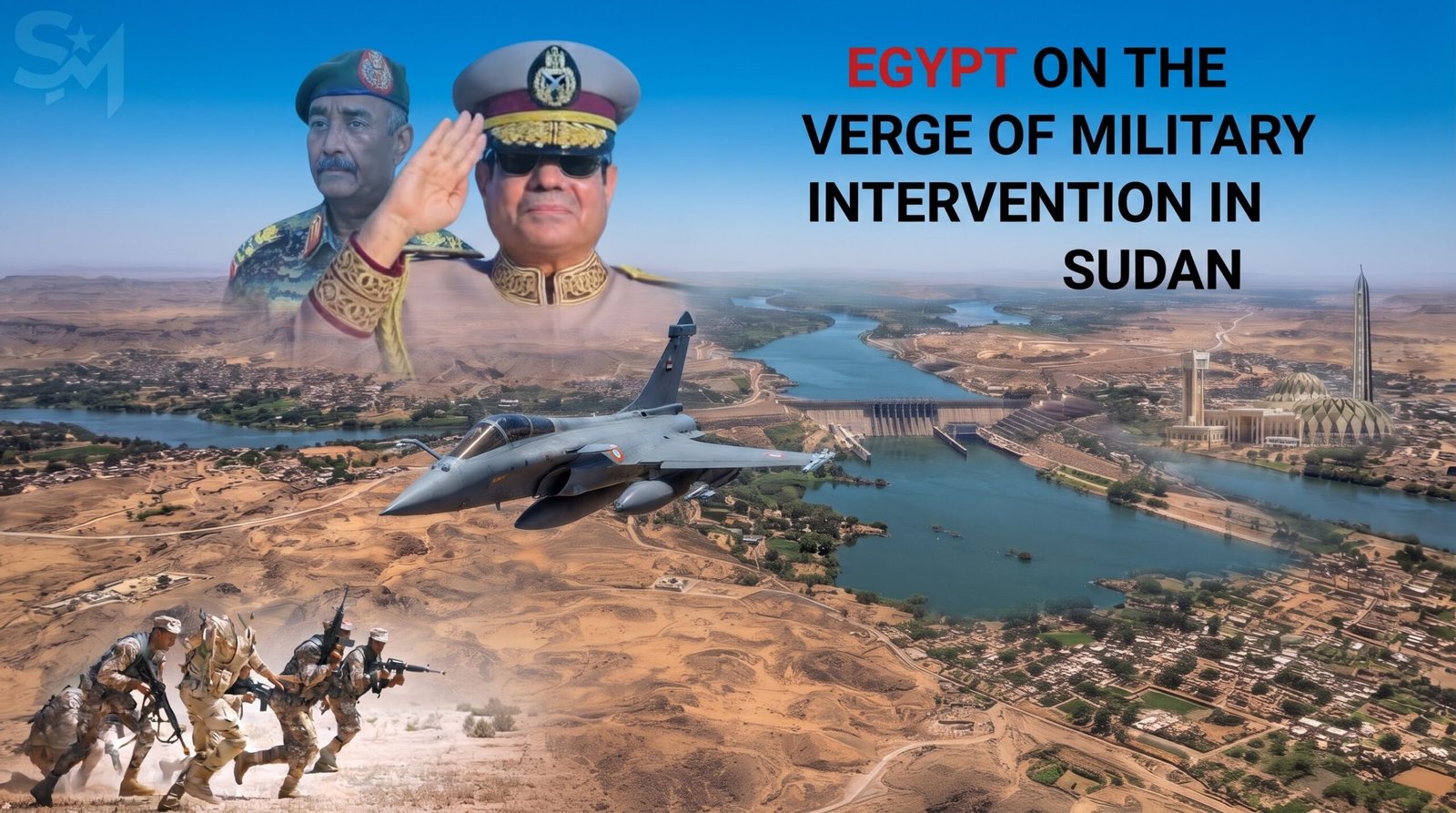
Blue Nile Crossroads: Why Egypt Is Shifting Toward Preemptive Military Deterrence in Sudan
By: Mujahed Bushra
The region stands at a historic crossroads where geopolitical fault lines across the Nile Basin and the Red Sea intersect. What began in mid-April 2023 as an internal struggle for power in Sudan has evolved into an open arena for regional rivalries that are reshaping the balance of power in East Africa and the Middle East. Against this backdrop, senior Sudanese military sources have indicated that direct Egyptian military intervention in Sudan could be imminent.
As field developments accelerate in Sudan’s Blue Nile region—with the Rapid Support Forces (RSF) and their allies in the “Tasees” (Founding) alliance advancing toward the outskirts of Ad-Damazin and the Roseires Dam, alongside escalating accusations from Port Sudan that Addis Ababa has opened its territory for logistical supply hubs and strategic drone launches—Cairo faces a decisive strategic moment that puts its traditional military doctrine to a severe test of deterrence and survival.
In geopolitics, certain territories derive their value not merely from their size or domestic resources, but from their position as critical choke points along vital transboundary arteries. Sudan’s Blue Nile region is a textbook example. Serving as Sudan’s southeastern gateway, it shares a direct border with Ethiopia’s Benishangul-Gumuz region, where the Grand Ethiopian Renaissance Dam (GERD) sits just a few dozen kilometers from the Sudanese frontier.
At the heart of this region lies the Roseires Dam. Far more than a domestic facility for hydroelectric power and agricultural irrigation, Roseires serves from an engineering and security standpoint as the first regulatory buffer for Blue Nile waters after they exit the GERD reservoir. Through its gates and storage capacity, water flows heading north toward Sennar State, Khartoum, and the main Nile all the way to the Aswan High Dam are managed and calibrated.
Given this geo-engineering reality, any shift in territorial control around Ad-Damazin and the Roseires Dam in favor of the RSF and the Tasees alliance carries severe strategic implications for Egyptian national security:
First:Monopolizing Control Over the Blue Nile Artery: The fall of the region would effectively place the course of the Blue Nile—from its source in the Ethiopian Highlands deep into central Sudan—under a single aligned axis, stripping both Egypt and Sudan of vital technical and negotiating leverage in managing the water crisis.
second: Breaching Central Sudan’s Defensive Depth: Historically and militarily, the Blue Nile region represents the soft underbelly of Sudan’s central states. Control over Ad-Damazin and Roseires reopens the overland corridor toward Sennar State, and from there into Al-Jazirah and White Nile states, threatening the safe zones where the Sudanese Armed Forces (SAF) concentrate their core weight.
third: Establishing a Parallel Entity on Egypt’s Water Frontier: Decision-makers in Cairo recognize that enabling the Tasees alliance to capture a resource-rich, water-strategic border region entrenches the de facto partition of Sudan and establishes a hostile authority directly along Egypt’s vital water lifeline.Evolution of Egyptian Doctrine: From Diplomatic Containment to Preemptive DeterrenceSince the outbreak of the Sudanese war, Cairo has pursued a cautious approach characterized by “constructive ambiguity” and indirect support for the SAF. This posture rested on complex calculations: avoiding a costly ground war of attrition beyond its borders amid domestic economic pressures, preventing direct friction with major Gulf powers with whom Egypt maintains strategic investment partnerships despite diverging views on Sudan, and keeping the Egyptian military focused on securing its eastern border with Gaza and its western frontier with Libya.
However, the rules that governed Egyptian policy over the past two years are no longer viable in the face of late-2026 realities. Official communiqués from Egyptian-Sudanese summits, explicit invocations of the 1976 Joint Defense Agreement, and clearly drawn red lines regarding Sudan’s territorial unity and the rejection of parallel governing entities all signal a fundamental shift in Cairo’s strategic mindset—from “crisis management” to “threat neutralization.”Egypt’s military establishment has concluded that intelligence sharing, training, and limited arms supplies may prevent the total collapse of the SAF, but are no longer sufficient to deter direct external intervention—especially after strategic drones and advanced air defense systems disrupted the battlefield balance and began threatening critical infrastructure in eastern and northern Sudan, edging closer to Egypt’s southern border.
Engineering Egyptian Intervention: Smart Power and Surgical Deterrence
When discussing potential Egyptian military intervention in Sudan, many observers fall into the trap of imagining large-scale ground invasions and armored divisions crossing the border. In reality, modern Egyptian military doctrine—informed by contemporary regional conflicts—treats a full-scale ground offensive as a costly last resort, favoring instead “surgical deterrence and securing strategic depth” across four calibrated operational tiers:
First: Superiority and Counter-Drone Defense: Neutralizing hostile unmanned aerial vehicles (UAVs) represents the top priority for any Egyptian deployment in the Blue Nile and eastern Sudan. This entails deploying medium- and long-range air defense systems, supported by early-warning radar networks and advanced electronic warfare units, to jam and intercept suicide and reconnaissance drones around Ad-Damazin, the Roseires Dam, Gedaref, and Port Sudan—protecting critical water infrastructure and eastern logistical hubs.
second: Precision Stand-Off Strikes: The Egyptian Air Force possesses formidable long-range strike capabilities, including Rafale fighters, upgraded F-16s, aerial refueling tankers, and armed drones. Should cross-border attacks from the Ethiopian frontier toward the Blue Nile or Gedaref persist, Cairo’s most likely option is executing limited, high-precision airstrikes targeting supply convoys, ammunition depots, staging camps, and drone launch sites within the operational theater to sever logistical lifelines without committing Egyptian infantry to urban or jungle warfare.
third: Joint Operations Rooms and Intelligence Integration: Modern warfare hinges on real-time intelligence and rapid fire response. Egypt’s role is poised to expand into advanced joint operations rooms staffed by Egyptian military reconnaissance and intelligence officers to supply the SAF with live satellite imagery, electronic surveillance data, and precision artillery and air-strike coordination—an operational edge capable of reversing ground dynamics in rugged areas such as Bau, Soda, and Kurmuk.
fourth: Targeted Protection of Strategic Ports and Northern Corridors: Should field conditions deteriorate and threats approach Sudan’s northern states or the Red Sea coast, Cairo could deploy select special forces, paratroopers, and facility-protection units to secure strategic Red Sea ports and vital northern corridors, safeguarding supply lines, preventing instability from spilling into southern Egypt, and protecting international maritime navigation in the Red Sea.
Regional Balances and the Cost of Inaction
Cairo does not operate in an international vacuum; its military calculus in Sudan is shaped by an intricate web of regional and global balances. On one hand, Egypt manages its policy differences with the United Arab Emirates with high political pragmatism—compartmentalizing bilateral economic and investment cooperation from direct national security imperatives in the Nile Valley, while signaling clearly that Sudan’s security and Nile water rights remain non-negotiable priorities. On the other hand, Cairo is capitalizing on growing strategic alignment with Riyadh, which shares Egypt’s concern over the fragmentation of the Sudanese state and the transformation of the Red Sea coast into an open conflict zone threatening regional stability and mega-development projects.
Globally, the preoccupation of major powers with conflicts in Ukraine, the Middle East, and Indo-Pacific competition affords regional actors broader latitude to shape facts on the ground. Against this reality, Cairo recognizes that passive waiting is no longer a safe option. Geopolitical history demonstrates that security vacuums are swiftly filled by rival forces, and the cost of limited preemptive intervention to protect the Blue Nile gateway and prevent the fall of Roseires remains far lower than fighting an existential war later after maps have been redrawn and water realities imposed by force.
Today’s battle on the outskirts of Ad-Damazin and the Roseires Dam extends far beyond the borders of the Blue Nile region to touch the very equation of survival in the Nile Valley. A unified, military-backed Sudan represents the sole strategic buffer protecting Egypt’s southern flank and safeguarding its Nile water share. With mounting field indicators of regional actors fueling the conflict and opening new fronts of attrition along Sudan’s eastern and southeastern borders, Egyptian military intervention—through smart air, intelligence, and defensive power—looks less like a debatable political choice and more like an unavoidable strategic necessity, even if it draws Cairo into a multifaceted conflict whose repercussions will be felt on every level.